
Seventy six flights. Twenty three domestic, fifty three international, ten long haul. The rest short and medium haul. The numbers are precise because every sector is tracked on Flighty, and seeing them arranged in sequence reframes what flying becomes over time. Movement turns into pattern. Privilege turns into repetition. The first flight in this stretch was Kuala Lumpur to Bangkok, a short sector that did not technically require business class, yet it was booked anyway for ease rather than necessity. Priority check in removed waiting. A wider seat meant landing without stiffness. Being first off the aircraft shortened the wait at immigration. Even then, a principle emerged quietly. The quickest way to arrive well is often the most efficient, not the most dramatic.

Efficiency Became the Centre
Once flying becomes routine, inefficiency grows louder. Packing stabilised into a system. The same cables, the same pouch, the same rhythm. Alcohol gradually disappeared from in flight routines because even a single glass made the landing feel heavier. Window seats remain the preference, partly for the view, mostly for the quiet and sense of orientation. On long haul sectors, proper rest became non negotiable. A flat bed is not indulgence. It is preservation. Landing rested sharpens thinking. Landing tired affects everything that follows. What once felt like a perk slowly became a form of energy management.

More Expensive Does Not Mean Better
Frequency recalibrates how value is measured. A higher fare or a First Class label does not automatically translate into a better experience when the fundamentals are missing. Beautifully designed cabins can still feel inefficient, while simpler ones operate seamlessly. Of the 23 domestic flights, many were on Firefly rather than Malaysia Airlines because the airports are closer and the journey faster, especially compared to Kuala Lumpur International Airport. To Penang or Singapore, speed outweighs cabin class. Price becomes secondary when convenience, timing and energy are the real currencies.
Not All Lounges Are Created Equal
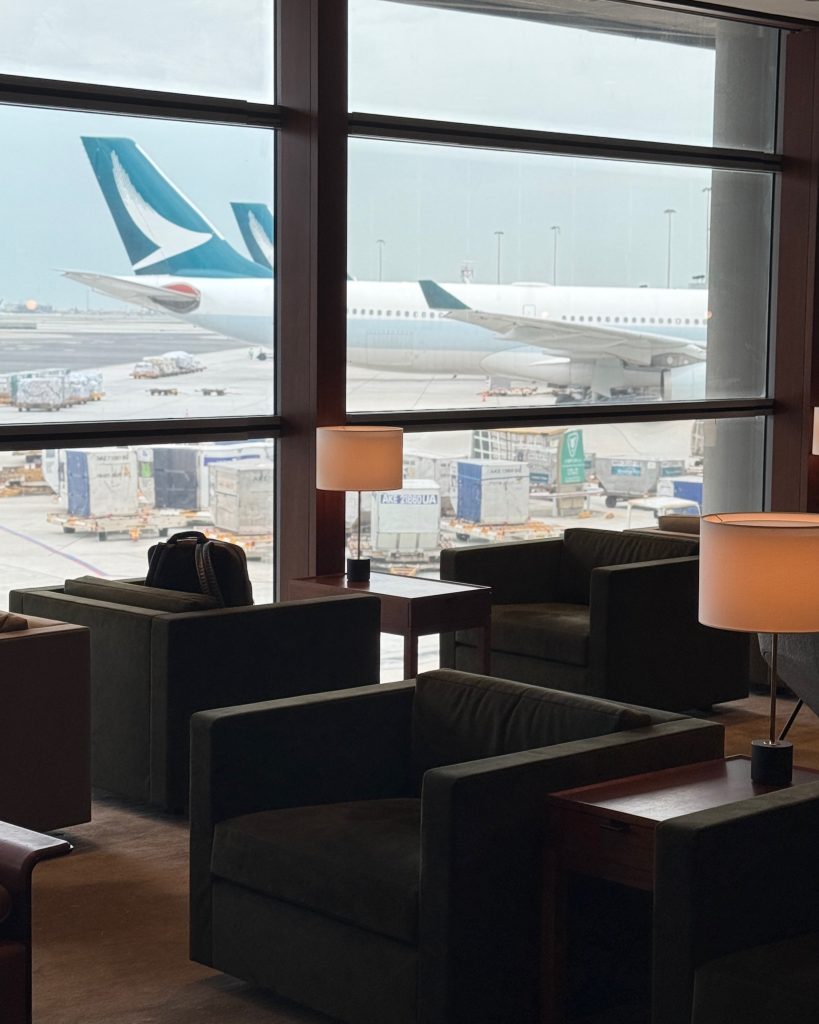
Lounges once felt like a privilege. Over time, they became a way to manage energy between departures. Not all are equal, and the most impressive is not always the most restful. At Hong Kong International Airport, the The Pier by Cathay Pacific is easily still one of the best in Asia. SilverKris Lounge at Singapore Changi Airport feels structured even during busy hours. The Golden Lounge at Kuala Lumpur International Airport remains familiar and predictable, particularly for Malaysia Airlines. Suvarnabhumi Airport stays a favourite because a proper massage resets the body in ways design cannot, while Shanghai Pudong International Airport offers surprisingly strong food options. Heathrow Airport and Charles de Gaulle Airport reward timing more than status. Doha’s Hamad International Airport impresses architecturally, yet calm does not always correlate with scale. The best lounge is simply the one that allows a proper reset.

Hospitality Makes All The Difference
A delayed Cathay Pacific flight in Hong Kong that kept passengers seated for close to two hours sharpened expectations. Weather is uncontrollable. Communication is not. What unsettled the experience was not the delay itself, but the absence of clarity in their home base, where efficiency should feel instinctive. The seat was comfortable, yet the silence amplified frustration. On another occasion, travelling as Enrich Platinum and Oneworld Emerald with Malaysia Airlines, staff suggested switching to an earlier flight before being asked, saving hours and creating more time at the destination. During a separate delay, beverages were offered and apologies were direct. Weather delays equalise everyone. What remains is tone. Giving people clarity and time back matters more than any cabin configuration.

Some Plates Are Better Than Others
Airline food across mainland Chinese carriers was once assumed to be inconsistent. That assumption did not last long. Hainan Airlines delivered meals that felt thoughtful rather than industrial, with confident seasoning and balanced textures. XiamenAir and Shenzhen Airlines both surprised with properly executed hot dishes that respected regional flavours, while China Eastern Airlines produced meals that were genuinely satisfying in business class. Hainan Airlines in particular stood out not only for food, but for hospitality that felt steady and composed. Reputations often lag behind reality. Frequency closes that gap.

Options Over Allegiances
After enough flights, I stopped thinking about loyalty as devotion and started treating it as allocation. Enrich remains my primary currency because Malaysia Airlines offers the best bang for buck out of Kuala Lumpur, and Oneworld makes practical sense from my home base. Cathay Pacific stays in the rotation for comfort and network reliability across North Asia, while Singapore Airlines and Star Alliance provide route flexibility that Oneworld cannot, including access to carriers such as China Eastern Airlines. I consolidate where it creates leverage and branch out where it creates access.

Long Haul Became Reset Time
The ten long haul flights served a different function. With connectivity, particularly on Malaysia Airlines where internet access is often complimentary, I write more clearly at altitude than on the ground. I catch up on series I never have time for. Short haul is transactional. Long haul is reflective. Yet even a flat bed has limits. A routing from Shanghai Pudong International Airport to Beijing, onward to Tijuana and then Mexico City across four consecutive sectors was exhausting despite the seat. Comfort softens travel. It does not remove cumulative strain.
When Small Things Start to Matter
Tracking these 76 flights made the lessons harder to ignore. The numbers show delays, routes and repetition without exaggeration. With repetition comes a different kind of discernment. Patience for avoidable friction thins, while appreciation deepens when service staff anticipate rather than react. There is a trade off. Frequent travel compresses some friendships while strengthening others who share a similar rhythm. After 76 flights, travel will likely become more selective but not less intentional. What matters now is arriving with clarity, with enough energy left to engage fully, and with systems that function quietly in the background.